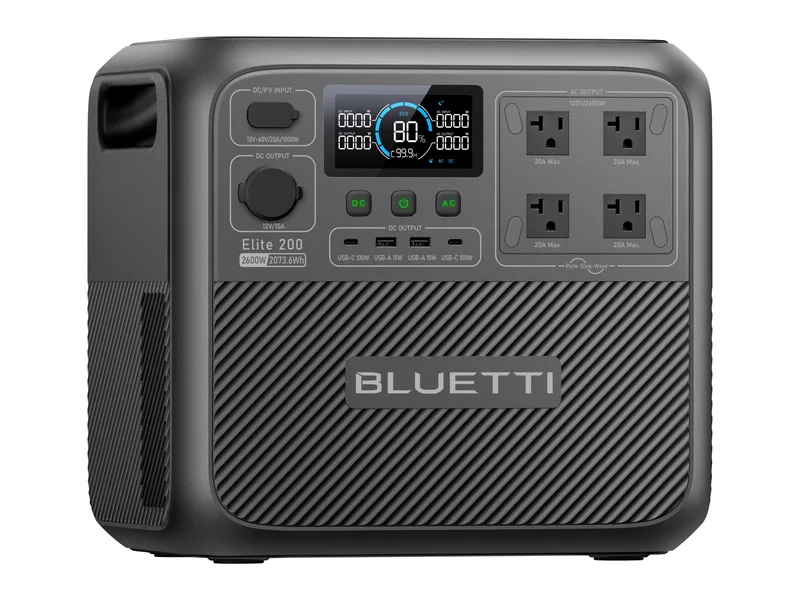
BLUETTI Elite 200 V2
Enough battery for a real outage night, still liftable by one adult.

Size a power station for the appliances you will keep running, not your house square footage. Add watts × hours for each load, allow for losses and reserve, then separately check voltage, continuous output and startup demand. Plug-in backup and powering house circuits require different equipment.
We may earn a commission when you buy through our links. As an Amazon Associate I earn from qualifying purchases. Affiliate disclosure
Research-based, not lab-tested. Read our research method and match the documented requirements to your household before purchasing.
For a house, the useful question is which appliances must run and for how long. A battery that supports phones and a few lights may be useful without supporting a refrigerator, pump or central air conditioner. House area does not establish those electrical requirements.
This worksheet is research-based, not lab-tested. It calculates a planning scenario; it does not assess your wiring or guarantee product runtime. The Virginia Tech energy-use guide explains energy calculations and why appliance duty cycles matter.
There is no new interactive script. Copy these steps to paper or a spreadsheet, or print the page from your browser.
Use measured or documented energy for your own appliances. A nameplate maximum is not necessarily a refrigerator’s average draw, and a utility bill includes loads you may disconnect during an outage. Measure plug-in devices safely during normal use or consult their manufacturer. Do not open an electrical panel to fill in this table.
Every load and duration below is hypothetical. The assumed 80% usable-energy fraction and 20% reserve are planning choices, not a manufacturer’s efficiency claim or measured household profile.
| Hypothetical load | Assumed average watts | Hours | Delivered energy |
|---|---|---|---|
| Refrigerator, cycle-averaged | 60W | 12 | 720Wh |
| Router and modem together | 15W | 12 | 180Wh |
| LED lighting together | 10W | 5 | 50Wh |
| Phone charging session | 10W | 2 | 20Wh |
| Total | 970Wh |
The arithmetic is 970 ÷ (0.8 × 0.8) = 1,515.625Wh, or about 1,516Wh rated capacity under these assumptions. Round up to a suitable available capacity and still complete the electrical checks below. A unit near that threshold may fail your real scenario if your appliance draw or losses are higher.
The same formula, with the same hypothetical loss and reserve assumptions:
| Average combined load | Duration | Delivered Wh | Calculated rated Wh, rounded up |
|---|---|---|---|
| 50W | 8 hours | 400Wh | 625Wh |
| 100W | 8 hours | 800Wh | 1,250Wh |
| 100W | 16 hours | 1,600Wh | 2,500Wh |
| 250W | 8 hours | 2,000Wh | 3,125Wh |
These are arithmetic examples, not estimates for a specific home. Increasing hours changes stored-energy needs even when the output in watts stays the same. Medical equipment needs a separate supplier-approved plan; use the CPAP guide for the questions to ask.
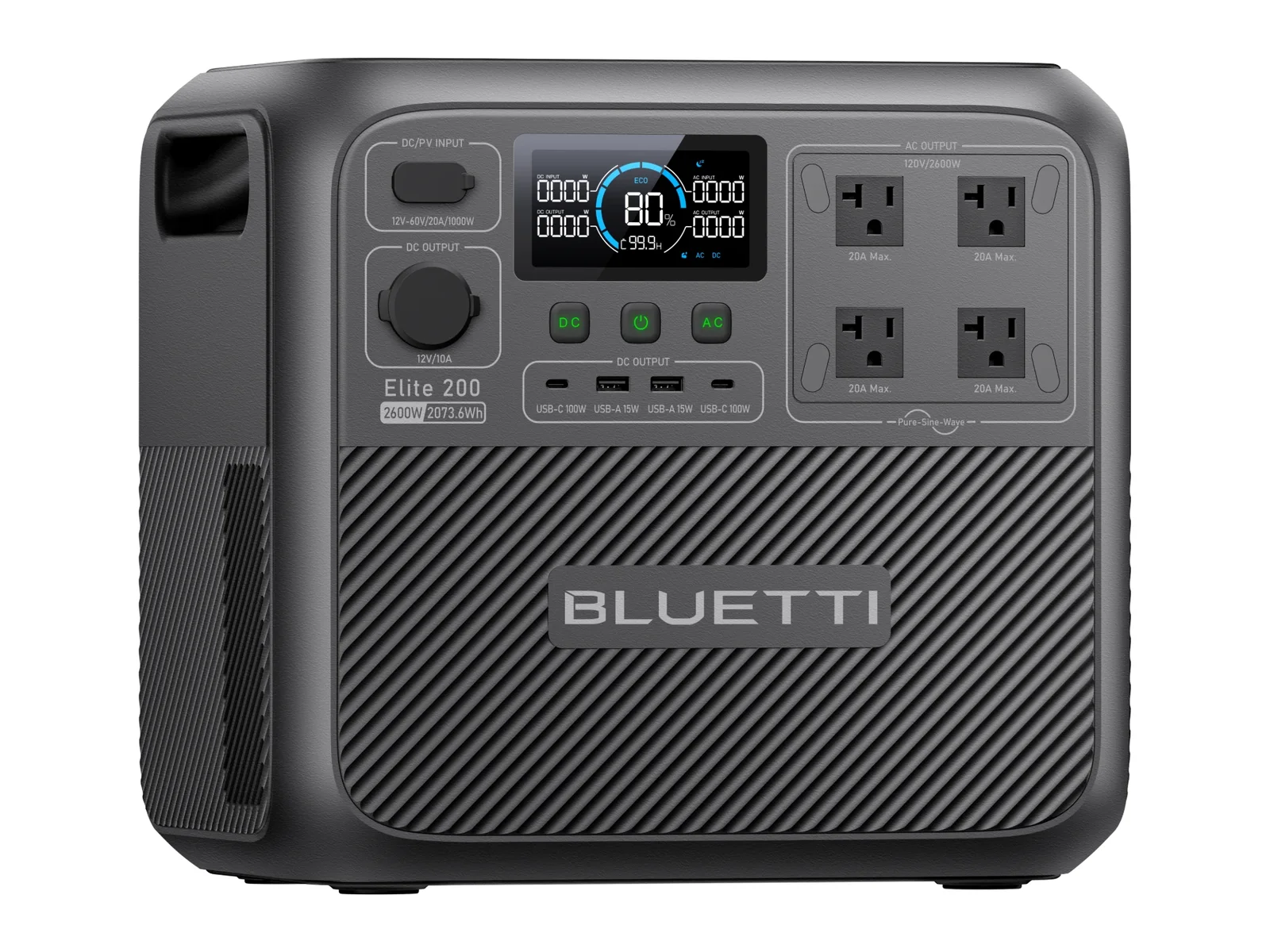
BLUETTI lists the Elite 200 V2 at 2,073.6Wh with 2,600W continuous output at 120V. Its rated capacity exceeds the worked example’s 1,516Wh result. That comparison makes it a candidate to investigate; it does not prove it will start your refrigerator or deliver twelve hours. It also does not establish support for 240V house loads. Check the ordinary output specification and the exact U.S. configuration before using the purchase links below.
For other candidates, compare home-backup stations. For a compressor appliance, read the refrigerator guide. Keep recharge assumptions explicit: a panel’s rated watts are not a promise of that output for every daylight hour. Use the panel compatibility guide.
Powering selected appliances directly from a station differs from connecting a house’s circuits. Never feed a house through a wall outlet. Have a qualified electrician assess any transfer equipment, wiring, permits and compatible system. A portable unit’s capacity headline does not authorize a circuit connection.
It depends on loads, hours, voltage, output and connection equipment. Two thousand watt-hours alone cannot establish whole-house operation. Start with essential appliances and a replenishment plan.
Extra energy can help, but it cannot fix the wrong voltage, an inadequate inverter or an unsafe connection. Calculate first, then check those limits before buying.
No. The image identifies the pictured product. Confirm exact device requirements, connections and the recharge plan independently before relying on the setup.
Updated Oct 14, 2026: clarified the static worksheet, loss and reserve assumptions, and the checks that capacity alone cannot answer.
Enough battery for a real outage night, still liftable by one adult.
