
What the order does
As of Oct 14, 2026, DOE Order 202-26-50 is in its October 13–16 effective period. It is not an announcement of a scheduled blackout at your address. Keep following your local utility’s instructions rather than treating a regional headline as an outage forecast.
The Department of Energy’s announcement identifies elevated demand, planned autumn generator maintenance and transmission outages as reasons for the action. It authorizes additional generation measures to help PJM maintain reliability, including backup generation as a last resort before or during an Energy Emergency Alert 3.
The order itself was signed on October 12; its operating period begins October 13 and ends October 16, with some reporting and compliance obligations continuing separately. PJM’s October 13 notice explains applicability to specified resources and backup generators at large loads. This is an operator instruction, not a direction for homeowners to connect generators to the grid.
Who is in the PJM region?
PJM’s service territory includes all or parts of Delaware, Illinois, Indiana, Kentucky, Maryland, Michigan, New Jersey, North Carolina, Ohio, Pennsylvania, Tennessee, Virginia and West Virginia, plus the District of Columbia. Living in one of those states does not establish that every address is served through PJM.
Check the utility on your bill and its outage information. The regional operator manages the wholesale system; your utility is the useful source for address-level service updates. This report does not identify affected households or promise an outage duration.
A 15-minute household check
This is our suggested review sequence, not a DOE timetable or a guarantee that preparation takes exactly 15 minutes. Work through the items you can safely check now.
- Save the alert route. Locate your utility’s outage page, keep its contact information available and review how you receive local notices.
- Charge communications. Charge phones and the power banks you already own. Put a paper contact list where the household can find it.
- Find lighting and radio supplies. Check battery lights, the radio and their power sources. Make sure everyone knows where they are.
- Plan for the refrigerator. Keep the door closed during an outage and record when power was lost. FoodSafety.gov says a refrigerator can keep food safe for up to four hours without power when the door stays closed; use its item-by-item discard guidance rather than tasting food.
- Identify needs that cannot wait. For power-dependent medical equipment or temperature-sensitive medicine, use the provider’s and equipment maker’s backup plan. A generic battery purchase does not verify that need.
Backup power needs a safe operating plan
A portable battery’s energy capacity and its AC output are different limits. Check the appliance’s startup requirement, expected load and a realistic recharge route before relying on it. We do not promise a refrigerator runtime for any model.
CPSC’s generator guidance says fuel generators belong outdoors, at least 20 feet from homes, with exhaust directed away. Never operate one inside a home or garage, even with doors or windows open. Keep working battery-powered or battery-backup CO alarms on each level and outside sleeping areas. If a CO alarm sounds or poisoning is suspected, move outside to fresh air and call 911.
Our recommendation: check the household before shopping
Use working lights, batteries and communication supplies first. A regional reliability measure alone is not a reason to buy a larger power station.
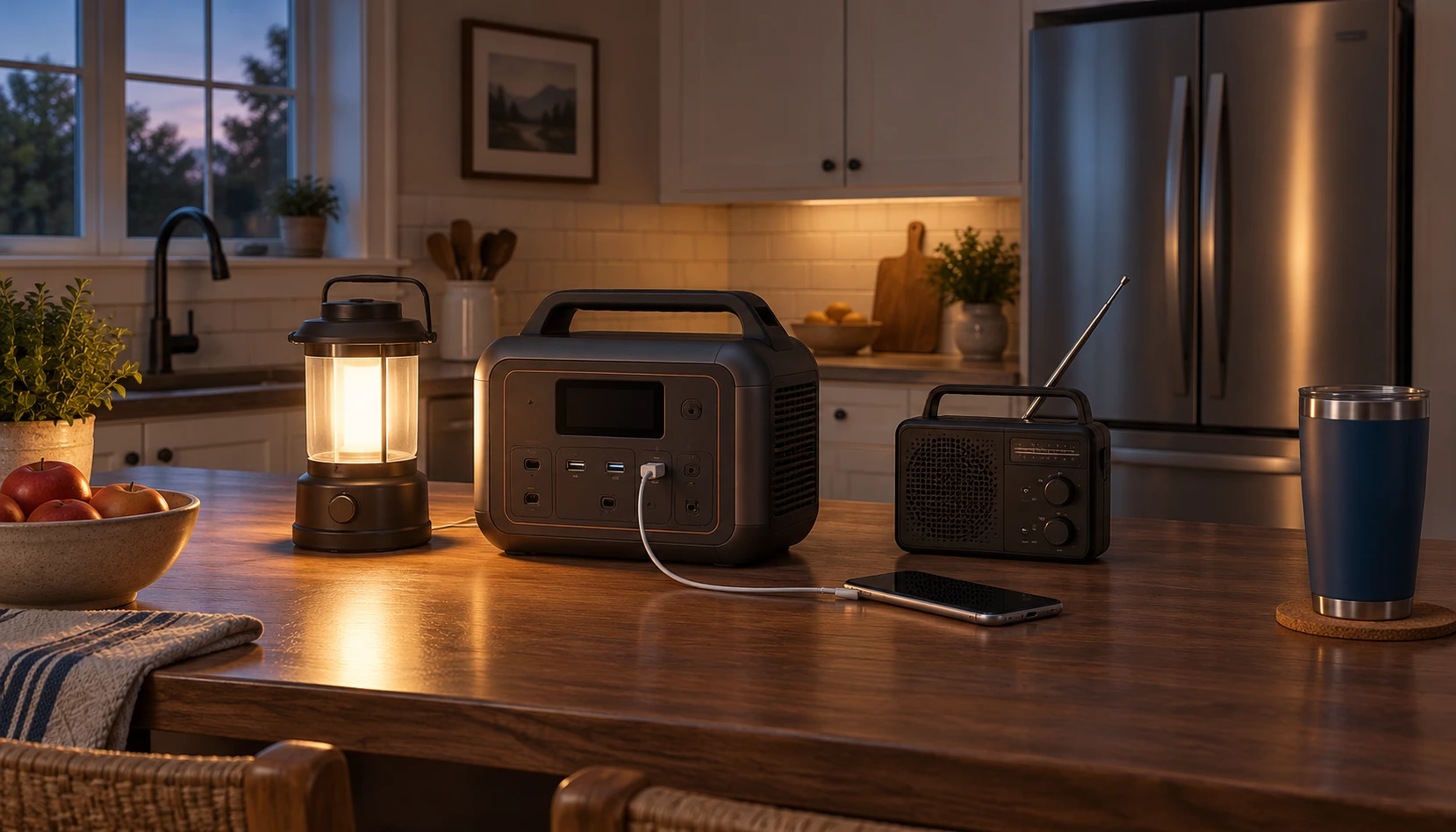
If you have a specific backup gap, check your refrigerator’s requirements, then compare the researched home-backup stations. If recharge, fuel or operating location changes the decision, our generator-versus-power-station guide lays out the trade-offs. The illustrated equipment is generic; it is not a product recommendation or a performance test.
