
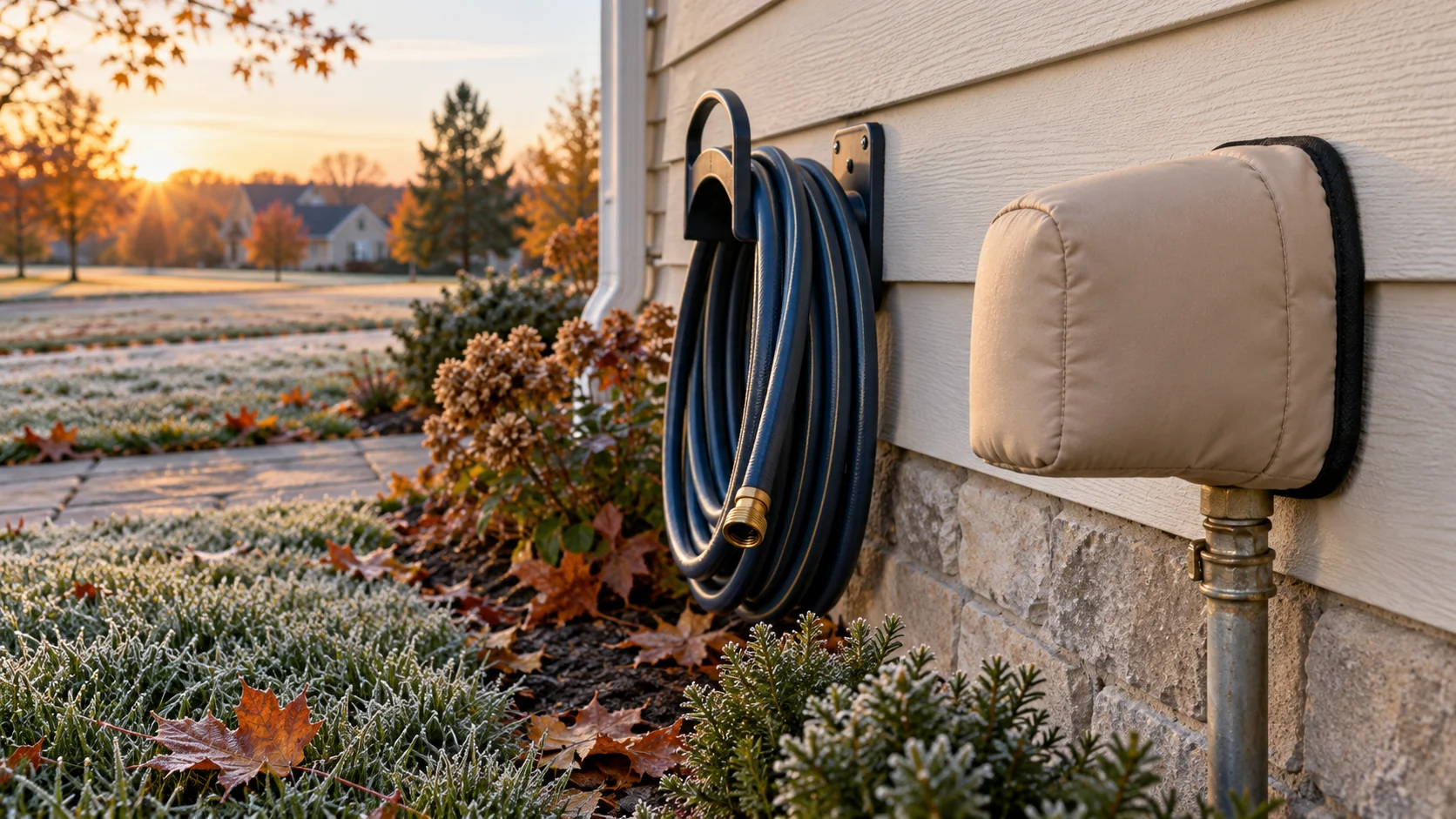
Freeze warnings issued Saturday point to a cold start on Sunday, October 18, across parts of the Ohio Valley, Appalachians and Northeast. Check your county’s current NWS warning, then disconnect garden hoses and protect exposed outdoor plumbing before temperatures fall. Use the short check below to review the outside of your home, safe heating and winter gear.
The 15-minute check is an editorial starting point, not a guarantee that a home or irrigation system is winterized. Schedule any work that needs a technician. A freeze warning also does not predict a power outage.
Where the warnings are
The NWS warning snapshot retrieved October 17 at 7:29 a.m. MDT includes the examples below. “As of” is the individual office’s issuance time on Saturday, October 17. Each row covers only the areas named in that bulletin, not an entire region or state. Saturday-morning warnings may already have ended by the time you read this.
| Selected area | Local warning window | Forecast low | NWS office | As of, Oct. 17 |
|---|---|---|---|---|
| Portions of Iowa | Until 9 a.m. CDT Sat., Oct. 17 | 29–32 °F | Des Moines | 2:24 a.m. CDT |
| Parts of east-central/southeast IN, northern/northeast KY and central/southern/western OH | 1–9 a.m. EDT Sun., Oct. 18 | Upper 20s to lower 30s °F | Wilmington | 12:18 a.m. EDT |
| Northwest NC, southwest/west-central VA and southeast WV | 1–9 a.m. EDT Sun., Oct. 18 | As low as 28 °F | Blacksburg | 5:41 a.m. EDT |
| Most of central Pennsylvania | 1–9 a.m. EDT Sun., Oct. 18 | 25–30 °F | State College | 1:07 a.m. EDT |
| Sussex County, NJ; Carbon and Monroe counties, PA | 1–9 a.m. EDT Sun., Oct. 18 | As low as 30 °F | Mount Holly | 2:10 a.m. EDT |
| Northern Fairfield, New Haven, Middlesex and New London counties, CT; western Passaic, NJ; Orange and Putnam, NY | Midnight–9 a.m. EDT Sun., Oct. 18 | As low as 30 °F | New York | 2:20 a.m. EDT |
The Wilmington bulletin is one example of the local alert to read in full. These are dated forecasts, not observed temperatures or a complete national warning list. Confirm the latest bulletin for your county; an area missing from this table may still need preparation.
For some households, this is the first freeze check of the season. That does not mean every listed community is experiencing its first freeze. The NWS cold-weather safety page explains that frost can also form when air temperatures remain above freezing. Protect vulnerable plants according to local advice, even when the alert is a frost advisory.
Start outside: hoses, faucets and irrigation
The NWS bulletins warn of damage to crops, sensitive vegetation and unprotected outdoor plumbing. Their preparation advice includes disconnecting and draining hoses, covering exposed pipes and draining in-ground sprinkler systems.
Walk the outside of the home before dark. Remove each hose from its faucet, drain it and store it. Check that exposed plumbing has the protection appropriate for that installation. A faucet cover is a preparation step; it cannot establish that every part of a plumbing system is protected.
Some NWS bulletins advise wrapping or draining outdoor pipes, or letting them drip slowly. Follow the direction appropriate to your installation and local utility guidance. Do not leave a hose connected as a substitute for protecting the faucet. If your irrigation system requires a particular shutdown procedure, follow its manufacturer’s instructions or arrange qualified help.
Bring vulnerable potted plants into suitable shelter or protect them as local guidance recommends. Include pets and other animals in the evening check. Review their shelter and water arrangements rather than assuming a brief cold spell needs no preparation. The Red Cross winter-storm guidance is a useful companion for household and animal planning as colder weather arrives.
Before the first heater run, check alarms and clearance
Use the seasonal change to test smoke and carbon monoxide alarms according to their instructions. Our smoke, CO and safe-heat guide helps organize that check. An alarm problem belongs on the immediate task list before relying on heating equipment.
The CPSC’s winter heating guidance says to keep portable heaters at least 3 feet from combustible materials and plug them directly into a wall outlet. Check the intended location before switching one on. Keep bedding, curtains and stored items out of that clearance.
If your backup plan includes a fuel-powered generator, CPSC says to operate it outside, at least 20 feet from the home. Never run one in a garage or other enclosed space. Read the safety instructions before an outage, while you have light and time to plan its location.
Check stored hand warmers for the Gobi Heat recall
Before charging winter accessories pulled from storage, check their model labels. The CPSC recall dated October 1, 2026 covers Gobi Heat rechargeable hand warmers, model UT3053, because their lithium batteries can overheat and create fire and burn hazards.
If yours matches the recall, stop using it and follow Gobi Heat’s recall instructions for the remedy. Use the recall’s household hazardous waste disposal directions; do not put the batteries in household trash. Check the model rather than assuming that every hand warmer sold under the brand is affected.
Turn tonight’s check into a winter outage plan
After the outside check, review how your household would manage heat, lighting and communication without electricity. Ready.gov’s winter-weather guidance provides the broader preparedness context. Use supplies you already have to identify gaps before buying anything.
Start with the winter power outage checklist for cold-weather priorities. Review the smoke and carbon monoxide guide before choosing a backup heating location. Then check the winter car emergency kit for anyone who must travel and the household power outage kit for lighting and charging essentials. Finish by sharing the plan with everyone at home.
